
Written by:
Liz Such, King's College London and KNOW-PH
Andy Tattersall, science communications consultant and KNOW-PH

Making better use of evidence in policymaking often implies making a difference on a grand scale. ‘Policy impact’ in research assessment exercises, among research funders, and even in university staff promotions criteria, has a built-in assumption that it should be national at least, international at best. Yet policymaking often occurs on a much smaller scale. Indeed, the trend in the UK is toward more devolved, tailored government to meet the needs of local communities. The English Devolution White Paper makes this clear. So, what is being done to match knowledge mobilisation practice with this trend? And how can it add value to the local policymaking landscape?
One attempt to fill this gap is our five-year programme, Knowledge for Public Health (KNOW-PH). Funded by the National Institute for Health and Care Research (NIHR) since 2023, its aim is to move research evidence closer to local public health decision making. We are a collaboration between four universities, City of Doncaster Council, the third sector organisation AFRUCA Safeguarding Children, and creative agencies. Our focus is mobilising evidence and other forms of knowledge (e.g. professional expertise, local knowledge) to improve public health and reduce health inequalities.
We are now halfway through the programme and have been reflecting on our experience. Using monitoring, learning and feedback data, we have generated six insights into how we (best) work to meet the needs of local government and add value to their processes (see Figure 1).
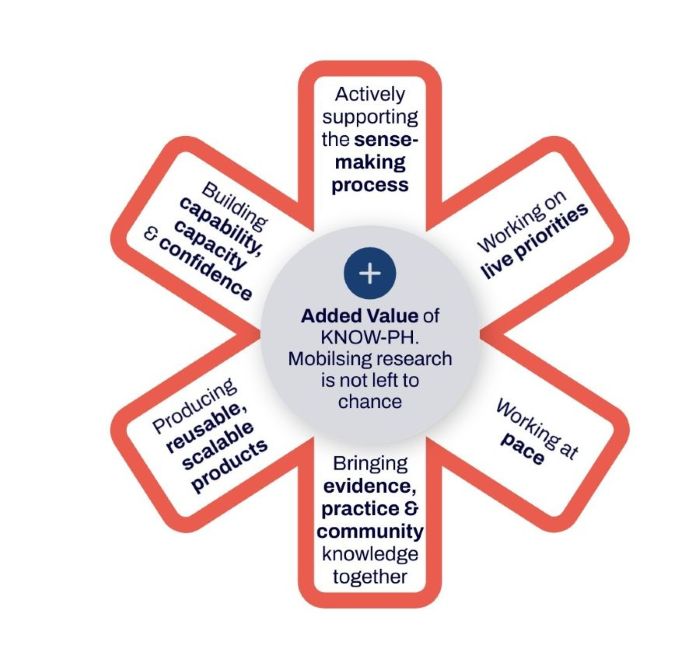
We are probably a long way away from establishing how, in the longer term, our work has influenced local policy, practice and change trajectories, but so far, we have established that the following features of our work are adding value.
1. We focus on sense-making, not solely knowledge sharing
We know that knowledge mobilisation is not a one-way street but a dialogue between knowledge users and producers. We intentionally blur the boundary between these stakeholders in our workshops, supporting local government officials and elected members to make sense of the evidence in their context. This is particularly important at a local level where context specificity is critical.
2. We focus on problems that are present and pressing
In KNOW-PH we draw from evidence that tackles the problems local government regard as most urgent, important or challenging. These are the 'windows of opportunity' so often cited in the evidence-to-policy literature. In doing this we match the entrepreneurship of the local policy maker with the skills of the knowledge mobiliser.
3. We work to timelines of weeks and months, not years
The timelines of policy and research are often characterised as out of step. Research is slow, policy is fast. Yet existing research is already out there, just waiting to be applied. We quickly search, sift and share evidence that helps answer questions that must be answered in a specific commissioning window or development timeline.
4. We intentionally blend insight from research with local knowledge
The evidence base rarely meets the exact needs of local government. We emphasise the value of all forms of knowledge including local testimony, neighbourhood data, public health professional insight and community voice. Our role is to bring this diverse knowledge together.
5. We are transparent, open and share everything of value
At a time when the information and evidence sphere is disrupted, not least due to the advent of generative and agentic artificial intelligence (AI), we attempt to make all we do open, transferable, accessible, evaluable and adaptable. By doing so we share our knowledge products, opening them up for scrutiny and, hopefully, re-use under Creative Commons licensing. Our open access archive is being continuously expanded.
6. We build in capacity concerns
We are acutely aware that we are a small team. So far we have worked closely with 13 local authorities in England, undertaking various communications outreach activities (e.g. podcasts, webinars, conferences, public engagement events) to spread learning. But there is only so much we can do to reach over 300 authorities. Our approach has been to build simple work models and methods – for example, our five-step ‘Evidence Learning Set’ method. We also use widely available software products such as Canva and Genially to create basic infographics and visually appealing learning materials.
Through KNOW-PH, we do not leave knowledge mobilisation in local government to chance. To evidence the overall impact of this goal, we anticipate conducting case examples of specific projects during the latter half of the programme and bringing the insights gained together with other parts of the local-level knowledge mobilisation community such as NIHR Health Determinants Research Collaborations, and NIHR Applied Research Collaborations. This will hopefully put evidence-to-policy and -practice at this less grand, but no less important, level firmly on the impact map.
This programme is funded by the NIHR Public Health Research programme (Award number: NIHR159057). The views expressed are those of the author(s) and not necessarily those of the NIHR or the Department of Health and Social Care.
Enter your name and email address to join the Transforming Evidence email list. You will receive a confirmation email — please click the link in it to complete your subscription.
You can unsubscribe at any time via the Transforming Evidence list page.
You can unsubscribe at any time via the Transforming Evidence list page.