Written by:
Bastien Kolt, World Health Organization

Despite decades of investment in health research, the persistent gap between what we know and what is done in policy and practice remains a defining challenge. Knowledge translation (KT) and evidence-informed policy-making (EIP) have emerged as critical responses – the approach, and the goal, respectively – but research on KT and EIP has grown in fragmented and uneven ways.
By developing a research agenda – a framework defining evidence gaps and priorities for future research – we have an opportunity to bring greater visibility and coherence to KT and EIP research, focus attention on the areas of greatest need and opportunity, and mobilise the partnerships and resources required to strengthen the use of evidence in policy and practice.
The World Health Organization (WHO), together with over 130 experts from 38 countries, has developed a Global Research Agenda on Knowledge Translation and Evidence-informed Policy-making. The effort builds on longstanding work to strengthen evidence use in policy-making – including the contributions of Transforming Evidence Network co-founders Annette Boaz and Kathryn Oliver.
Co-created between 2023 and 2025, the process involved extensive consultation with researchers, knowledge brokers, civil society actors and policy-makers across regions and sectors. It combined evidence reviews, expert inputs, and structured prioritisation methods to identify research areas that are impactful, inclusive, feasible, and important to study.
For readers interested in the methodological detail, the process is described in full in our recent paper in Health Research Policy and Systems (preprint available here).
The agenda identifies 19 priority research areas spanning three key domains of KT and EIP: interventions; barriers, facilitators and opportunities; and methods, standards, measurements, theories and frameworks (see figure below).
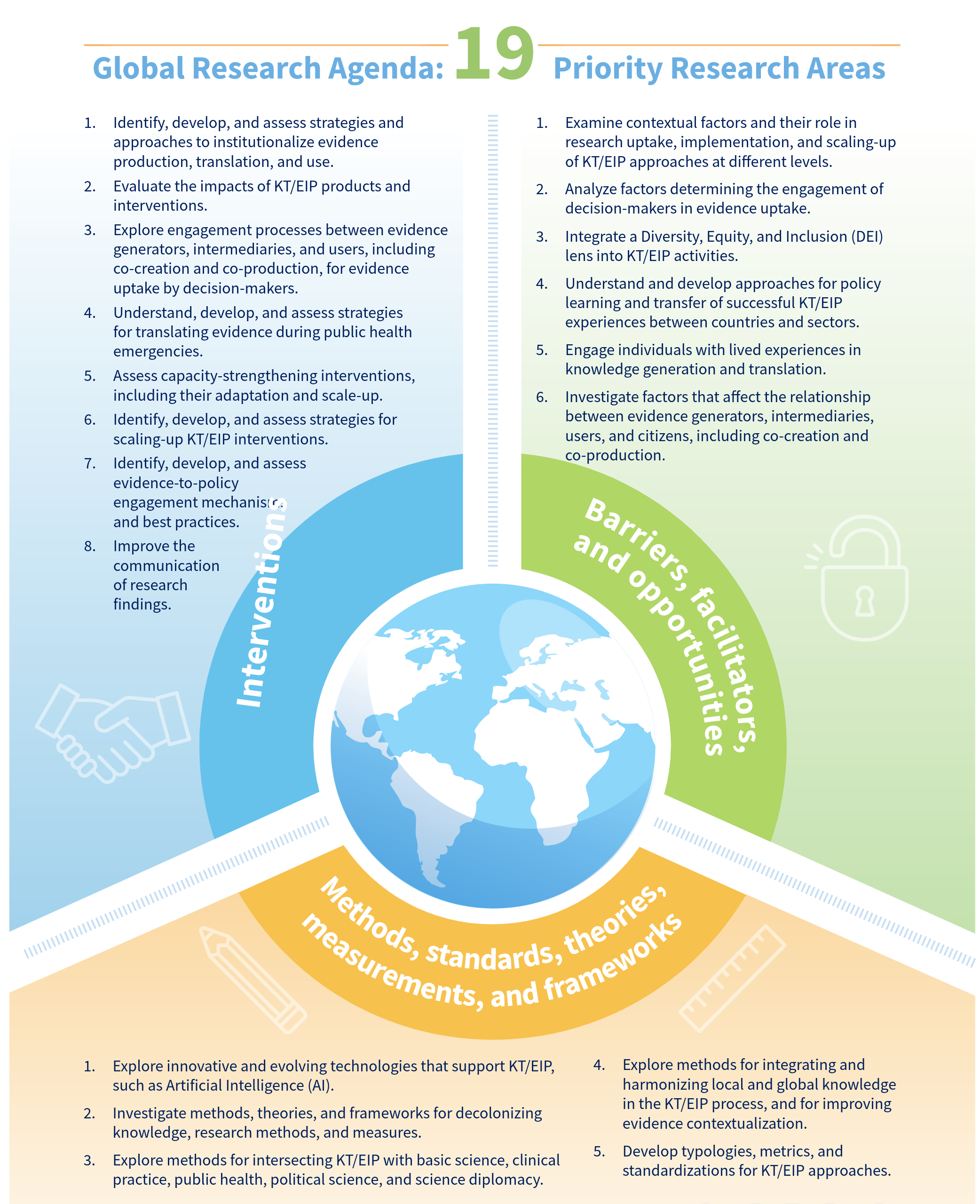
Figure: Overview of the 19 priority research areas
These priorities reflect both enduring challenges and emerging needs. They highlight, for example:
The agenda offers a strategic direction for the field. It is designed as a living resource – one that can be adapted to local contexts and sustained through initiatives such as the Global Coalition for Evidence, as well as ongoing webinar series and knowledge-sharing platforms. It will help shape research strategies, guide funding decisions, and strengthen collaboration between interest holders engaged in KT and EIP research.
Developing the agenda was only the first step. Its true value lies in how it is now used.
Encouragingly, we have already seen strong support from the global EIP and KT community. Researchers, funders, and knowledge brokers have rallied behind the agenda and expressed a clear commitment to advancing its priorities.
Building on this momentum, we see several immediate priorities for action:
As highlighted in our recent commentary in the WHO Bulletin, advancing research on KT and EIP requires coordinated action across the entire evidence ecosystem.
If we are serious about strengthening the use of evidence in policy-making we need to be equally serious about what research we prioritise, and how we act on those priorities.
We invite you to:
The Global Research Agenda is publicly available and free to use.
For more information or to engage further, please contact: [email protected]
Enter your name and email address to join the Transforming Evidence email list. You will receive a confirmation email — please click the link in it to complete your subscription.
You can unsubscribe at any time via the Transforming Evidence list page.
You can unsubscribe at any time via the Transforming Evidence list page.